

The work behind the work: what building a business looks like.
People see the finished work, but they don’t see the growing pains, the second-guessing, the late nights, or the hurdles along the way.
I was recently featured in Bold Journey, talking about what building Matchbox looked like, and some of the things I’ve learned along the way. It was a good conversation, but interviews tend to capture the highlights. This is the part underneath, the stuff that happens behind the finished work and rarely makes it into a feature.
If you run a business of your own, I’d bet at least one of these hits close to home.

Being good at the work doesn’t mean you know how to run a business.
Before starting Matchbox, I worked a corporate job and did freelance design on the side. I loved working with clients, solving the problem, and seeing something I made finally show up in the world. Eventually I started wondering what it would look like to make that the whole job, and I jumped.
Nobody warned me that being a good designer and running a creative agency are two completely different things.
Having your own business comes with finding clients, managing cash, setting expectations, keeping projects moving, and making decisions that affect people besides you. Somewhere in the middle of all that, you’re still supposed to be creative. I knew design and marketing. I didn’t know pricing, finance, sales, contracts, time management, or any of that other stuff. I learned them as I went, usually one mistake at a time.
I’m glad I didn’t wait until I felt qualified, because that feeling was never coming. Hell, I still don’t know if I’m qualified.
Confidence can get you started, but structure and financial discipline are what keep you going, and most of us only show up with one of the two.
If you’re great at your craft and struggling with the business side, you’re in good company. That gap is where almost every founder starts.
You’re probably more qualified than you feel
A few years ago, I was in New York City getting ready for a big client meeting, and I felt completely out of place.
I’d worked hard to get there, and I knew what I was doing. But sitting in a room surrounded by people and opportunities that used to feel far out of reach made me uncomfortable.
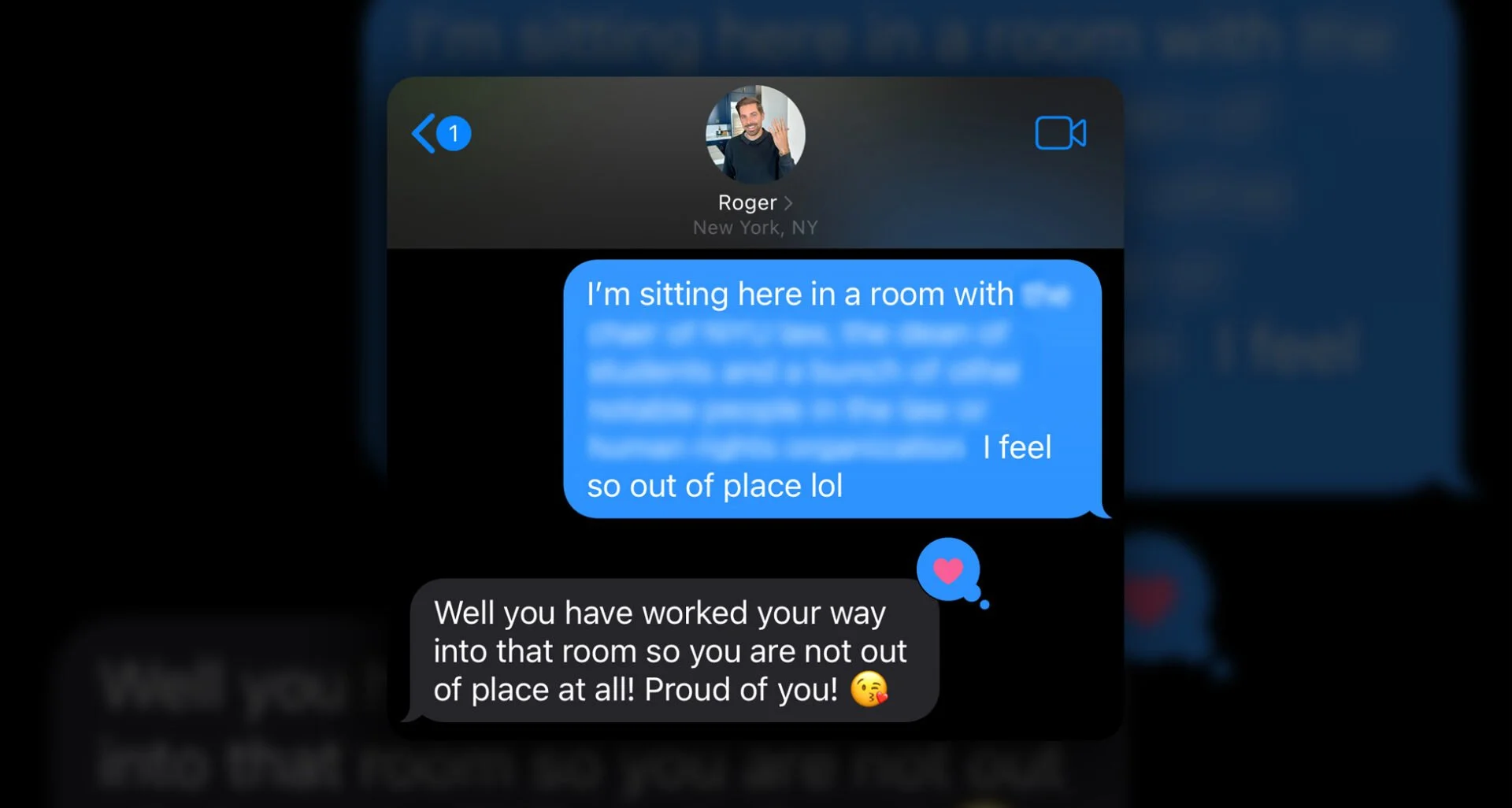
While waiting for everyone to get there, I texted my partner, Roger, and told him how I was feeling.
He wrote back that I hadn’t ended up there by accident. I’d worked my way into that room, and I had every bit as much right to be there as anyone else at the table.
I still have that text, and I still look at it anytime I’m feeling doubt.
If you know me, you know I can be pretty hard on myself, and dwell on what I could be doing better every day. That’s a hard feeling to overcome, but I found two things that helped:
Proof: Once we could show clients the traffic, leads, and revenue our work was producing, a lot of that guilt left on its own. Confidence came from being able to point at results, not from talking myself into it.
The people around me: Sometimes you can’t see what you’ve built because you’re standing too close to it. Roger could. That text didn’t make the doubt disappear, but it reminded me the doubt wasn’t the whole story.
Learning how to not take things personally.
There were projects I was excited about, relationships I was sure would go somewhere, and ideas I put a lot of time into that went nowhere.
Early on, I took every one of them to heart. When the business is yours, your confidence starts rising and falling with whatever happened that week. A new client feels like proof you know what you’re doing, and a lost one feels like proof you don’t.
Come to find out, those two things aren’t nearly as connected as they feel. Timing changes, budgets move, and companies head in a different direction. Sometimes you do everything right and it still doesn’t land.
It still stings, and I still hate losing work I wanted. What I’m trying to do now is judge the decision instead of the outcome. Was I prepared? Was I honest with them? Did I price it fairly? If the answer is yes, a no from the client is information, not a verdict.
The other half of this took me longer. Not every opportunity is the right one. When you’re trying to grow, yes becomes a reflex, and being busy starts to feel like being healthy. Some work costs more than it pays, in time, focus, or team morale, and passing on it is a business decision, not a failure. I wish I’d figured that out a few years sooner.
Being my own biggest roadblock.
This one is still very much a work in progress.
When you start a business, you’re in everything because there’s nobody else. You know every client and every project, you make every call, and you keep it all moving. Then the business grows, and you keep running it the same way, because it’s the only way you know.
Eventually it stops working. At some point I noticed how much of Matchbox ran through me. Clients came to me with questions, the team came to me for decisions, and I was in creative direction, strategy, client conversations, and a hundred small things every week.
Most of that came from caring about the work and wanting people taken care of. But caring about everything and touching everything aren’t the same thing, and some weeks I was the one slowing us down.
That’s not a fun thing to admit when you’re used to being the person who fixes things.
I recently read a piece by Austin L. Church called Don’t Burn Down Your Business Yet, and it put words to something I’ve been noticing in my business. He borrows an idea from Dan Martell’s Buy Back Your Time: entrepreneurs get so used to putting out fires that calm starts to feel strange, so they go looking for the next problem even when there isn’t one. Church calls the urge to keep changing things after the business starts working the “second itch.”
I recognized more of myself in that than I’d like to admit. Being the person everyone runs to feels useful. It feels like being needed. But some of the urgency that kept everything running through me was urgency I created myself.
Church also makes the point that a business starts to feel boring right around the time it starts working. I’m trying to treat the quiet as a good sign instead of a problem to go solve.
A quick way to tell if this is you: notice what stalls when you’re out for a few days. Whatever sits waiting for you is the list of things you haven’t handed off yet.
So I’ve been spending more time on how we work as a team: who owns what, how projects move, how we communicate with clients, and which processes make everyone’s job easier. Church lands in the same place. The job is building the systems and support that take you out of the middle. The goal isn’t to remove myself. I love this work, and I want to stay close to the parts I care about most. I just don’t want the business to depend on me touching every detail.
That means letting go, which I’m still learning to do. We have people at Matchbox with skills and ideas I couldn’t replicate on my own, and the agency gets better when I give them the room and the trust to do what they do best. Some weeks I get that balance right. Some weeks I don’t.
Navigating the ai landscape.
Wow. This section could be its own blog post: figuring out how the heck AI fits into your business.
I didn’t come into it as an expert. I’m learning it the same way I learned pricing and contracts, by trying things, getting some of them wrong, and keeping what works. Some weeks it feels like the ground is moving under everyone at once, and I’m not going to pretend I have it all worked out.
Where I’ve found it helps most, so far, is behind the scenes. Tracking time, sorting email, following up on proposals, and pulling my day together each morning used to eat my evenings, and now they take a lot less of my time. None of it is glamorous, and all of it used to land on me. It’s also helped with the bottleneck problem, because some of what used to sit waiting on me doesn’t anymore.
Less time on administrative tasks means more time focusing on clients.
That’s the trade I care about most. The admin can run quietly in the background, but the thinking, the decisions, and the relationships with our clients still come from people.
Growth changes what you need to be good at.
When I started, success was simple: get clients, do great work, build a reputation, and keep the lights on.
Those still matter. Now I care just as much about how the work gets made. I want clients to have a great experience, and I want our team to feel supported instead of pulled in twelve directions.
Growth brings responsibility. More people depend on your decisions, more clients trust you with their businesses, and the things you used to handle on the fly start needing a real system.
Nobody starts a business because they can’t wait to build better internal processes. I definitely didn’t. But slowing down long enough to fix what isn’t working has turned out to be some of the most important work I’ve done, even though none of it will ever show up in a portfolio.
Advice I’d give to another business owner:
1. Don’t wait to feel qualified.
That feeling might never show up, and the business will teach you plenty along the way. Start with what you know, then build the structure and money habits that keep you going once the excitement wears off.
2. Have a plan and follow it.
It’s tempting to chase every new idea, especially when something isn’t working yet. But if you’re doing things on a whim, you can’t tell what’s working and what isn’t, and you can’t grow what you can’t measure. Pick a direction, track it, and adjust based on what you learn.
3. Give yourself grace.
You’re going to make mistakes, and some of them more than once. Being patient with yourself isn’t the same as lowering the bar. It’s what lets you keep going long enough to get good at the parts nobody taught you.
4. Not every month is pretty.
Some months you’ll lose money, and that doesn’t mean the business is failing. Treat a bad month as a problem to diagnose. Find what caused it, fix that one thing, and keep moving.
5. Judge your decisions, not your results.
You can do everything right and still lose the deal. If you were prepared, honest, and priced it fairly, the outcome is something to learn from, not a reflection of your worth.
6. Say no more often.
When you’re trying to grow, yes becomes a reflex. But busy and healthy aren’t the same thing, and some work costs more than it pays in time, focus, and team morale. The work you turn down shapes the business as much as the work you take on.
7. Ask for help.
You’re not expected to know everything, and nobody builds a business alone. The people in your circle can be your biggest cheerleaders, and they’re often the first to jump in once you ask. Sometimes it only takes one text, like the one I sent from that meeting in New York.
8. Treat quiet as a good sign.
When the business finally starts to feel steady, the urge to change everything kicks in. Before you go looking for a new problem, ask whether things feel boring because they’re working.
9. Believe you belong in the room.
Self-doubt doesn’t go away when the business grows. It just shows up in bigger rooms. You earned your seat the same way everyone else did, by doing the work, so trust that and let the work speak when the doubt gets loud.
I’m still figuring it out as i go.
Running a business is hard. Even three years in, I’m learning something new every day. I don’t think I’ll ever reach the point where I feel like I have this figured out. The business changes, so the problems change. You learn something, adjust, and then you’re looking at a whole new set of questions.
There are decisions I’d make differently, situations I wish I’d handled better, and a few things I made harder than they needed to be. There’s also plenty I’m proud of: the relationships we’ve built with clients, the work our team puts out, and the people who’ve trusted us, pushed us, and helped make Matchbox what it is. None of it happened because of one person.
Every once in a while, I think back to that meeting in New York and the text from Roger. Most days I’m too buried in what’s happening right now to notice how far things have come.
If you’re somewhere in the middle of building something and still feel like you snuck into the room, you probably didn’t.

Get the other half of the story.
This post is what sits under the highlights. If you want the bigger picture of how Matchbox came together and what I’ve learned building it, my Bold Journey interview covers that.
Related articles: